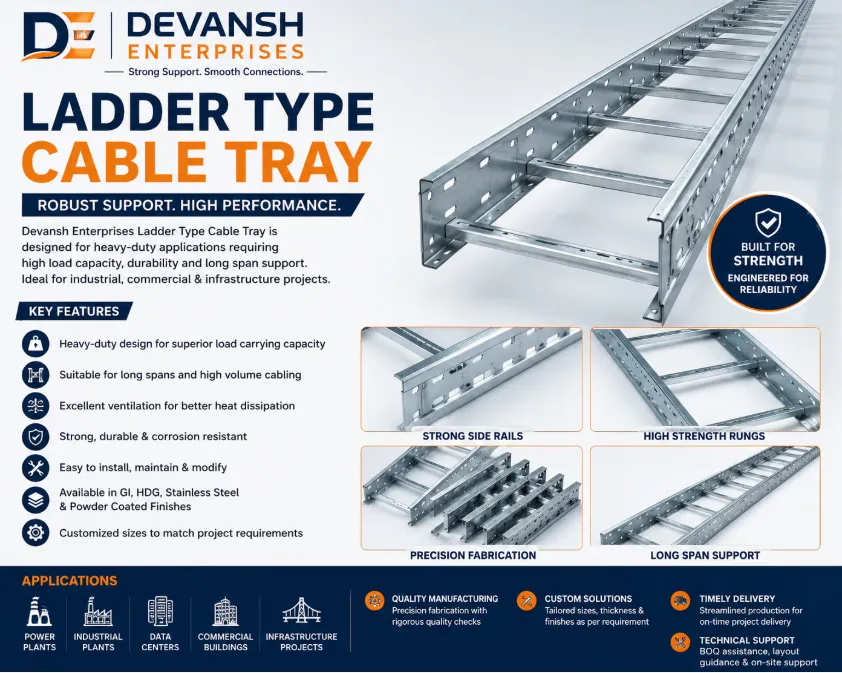
Heavy power cables require a supporting system that combines strength, ventilation, and installation accessibility. Ladder type cable trays are commonly used for this purpose in manufacturing plants, substations, utility facilities, commercial complexes, and large infrastructure projects.
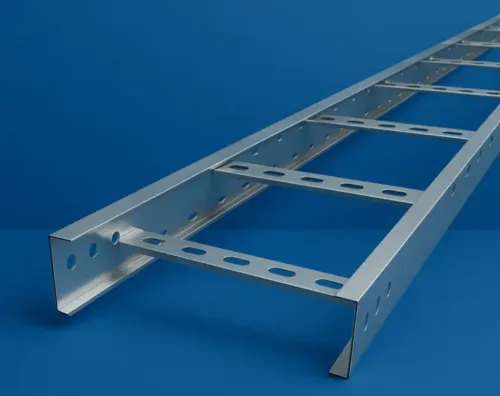
The system resembles a ladder, with two longitudinal side rails connected by regularly spaced rungs. Cables rest on the rungs and are secured at suitable intervals. The open construction allows heat to dissipate and gives technicians convenient access during installation and maintenance.
Applications Suited to Ladder Cable Trays
A ladder type cable tray manufacturer generally supplies these systems for demanding cable routes such as:
- Main power distribution lines
- Motor control centre connections
- Transformer and switchgear areas
- Heavy machinery installations
- Utility and process plants
- Electrical substations
- Solar and renewable-energy projects
- Large commercial service corridors
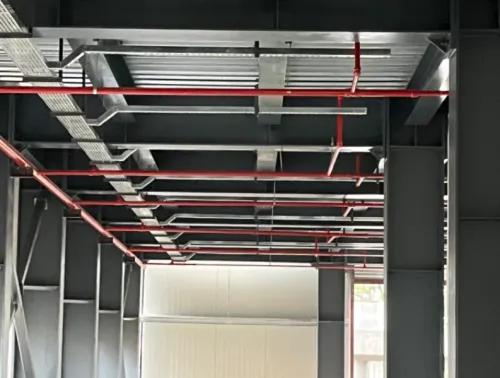
In Pune’s automotive and engineering facilities, ladder trays are often used to route power cables from electrical rooms to production equipment. They are also useful in facilities where cables travel over longer horizontal distances.
Why the Ladder Design Supports Heavy Cables
The side rails provide longitudinal strength, while the rungs support cables at defined intervals. This construction reduces unnecessary sheet material and provides an open pathway for cable ventilation.
The design offers several practical benefits:
- Lower heat accumulation around power cables
- Convenient cable entry and exit at different points
- Easier inspection of cable conditions
- Effective support for large-diameter cables
- Simple routing through industrial service areas
- Better access when circuits are added or replaced
The open design, however, means cables may need covers in areas exposed to falling objects, dust, direct sunlight, or other environmental conditions.
Rung Spacing and Cable Support
Rung spacing influences how well the tray supports different cable types. Large armoured cables may tolerate wider spacing, while smaller cables can require closer support or an additional base plate.
During specification, the project team should examine:
- Cable diameter and bending radius
- Total cable weight per metre
- Tray span between supports
- Route changes and vertical sections
- Cable fastening requirements
- Applicable project standards
Vertical ladder tray sections require suitable cleats or clamps because the cables cannot rely on the rungs alone for positional stability.
Choosing the Appropriate Material Finish
Environmental exposure determines the required surface protection. Indoor dry areas may use pre-galvanised steel, while outdoor and moisture-prone locations often require hot-dip galvanised trays.
Powder coating can provide a durable surface and help identify separate cable networks through colour coding. Stainless steel may be used where hygiene, chemicals, or persistent corrosion are important concerns.
Devansh Enterprises manufactures cable-support products for industrial requirements in Pune and other locations across Maharashtra. The selected tray should be compatible with the project’s structural, electrical, and environmental conditions.
Accessories Required for a Complete Route
Straight ladder tray sections cannot form an entire cable route by themselves. A complete system may need horizontal bends, vertical bends, tees, cross sections, reducers, couplers, covers, brackets, and fasteners.
Accessory dimensions and finishes should match the main tray. Poorly aligned bends or unsuitable couplers can create sharp transitions, stress cable jackets, and weaken tray joints.
Ladder type cable trays are particularly effective where cable weight, heat dissipation, and long-route accessibility are major considerations. Correct load assessment, support placement, material selection, and accessory planning allow the system to perform reliably in Pune’s varied industrial environments.
Keywords