A quoted tray length is only one part of a cable containment system. You will be able to check the supplied components, specify the finish and capacity, size the tray for your cables, and compare Pune quotations on an equivalent basis.
Key takeaways
- Request a line-by-line bill of materials, including bends, tees, covers and supports.
- Match coating type to indoor, outdoor, chemical and high-humidity conditions.
- Size tray width and loading from cable count, diameter, weight and expansion space.
- Check site dimensions, support spacing, bonding and earthing before delivery.
What should a complete powder-coated cable tray order contain?
A complete powder-coated cable tray order is a containment system, not a bundle of straight lengths. Ask for a line-by-line bill of materials instead of accepting “complete tray,” because missing fittings can halt installation or force site fabrication.
- Straight sections, with the specified width, depth, side-rail height and length.
- Horizontal and vertical bends, including inside and outside risers, tees, crosses and reducers.
- Coupler or splice plates, plus matching bolts, nuts and washers.
- Covers, end plates, support brackets, threaded rods and channel supports.
- Cable-drop accessories, such as drop-outs and radius-controlled exit fittings.
- Bonding or earthing jumpers where painted joints, expansion joints or the design require them.
Every fitting must match the straight tray’s width, side-rail height, hole pattern, coating and bend radius. A nominally compatible bend can still damage a power or control cable by forcing it below its minimum radius.
Confirm whether dividers are required for power, control, instrumentation, data or fire-alarm circuits; separation is a design decision, not an automatic inclusion.
For powder coated cable tray for details in Pune, give the supplier the tray profile, width, depth, straight length, material, thickness, support spacing, finish, fitting radius, cover requirement and loading criterion. Ask separately for powder coated cable tray accessories in Pune, with quantities and drawings.
Also confirm whether supports and fittings are fabricated together or sourced separately.
What does the powder coating specify, and where is it suitable?
1. Powder coating starts by preparing and degreasing the steel, then removing scale or rust. A dry powder is applied electrostatically and cured in an oven, where the particles melt into a continuous film.
2. Require the quotation for a powder coated cable tray in Pune to name the substrate: untreated carbon steel, pre-galvanized steel, hot-dip-galvanized steel, stainless steel or aluminium. It must also state pretreatment, powder chemistry, colour and specified dry-film thickness. Colour is decorative; it does not prove corrosion protection.
3. Match the coating system to the exposure. It can suit indoor dry rooms and specified humid plant areas, but outdoor UV and rain, chemical atmospheres and standing water need documented resistance.
Powder-coated steel is the wrong choice for severe abrasion, severe outdoor corrosion, high-temperature zones, buried installations, or projects requiring stainless steel, aluminium or hot-dip galvanizing.
4. Field-cut edges, drilled holes and installation scratches expose steel and create corrosion starting points. Require an approved touch-up method for each damaged area; do not accept an instruction to leave bare metal untreated.
5. Do not treat colour or coating thickness as a fire rating. They do not establish fire resistance, smoke performance or circuit integrity; those claims require a documented test of the complete tray-and-support arrangement for the project.
How do you select the tray profile, dimensions and capacity?
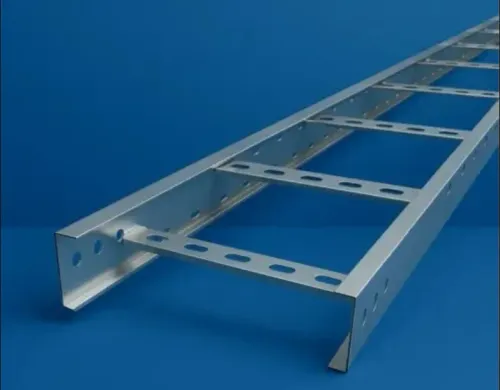
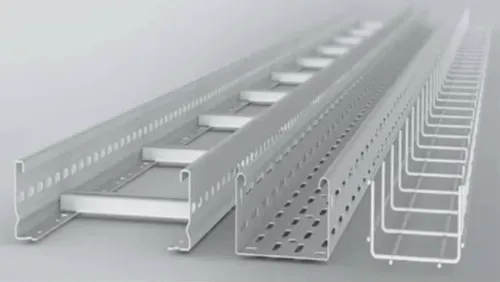
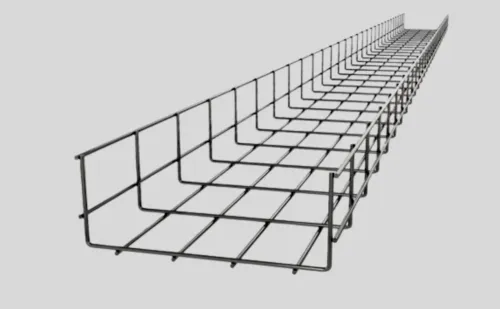
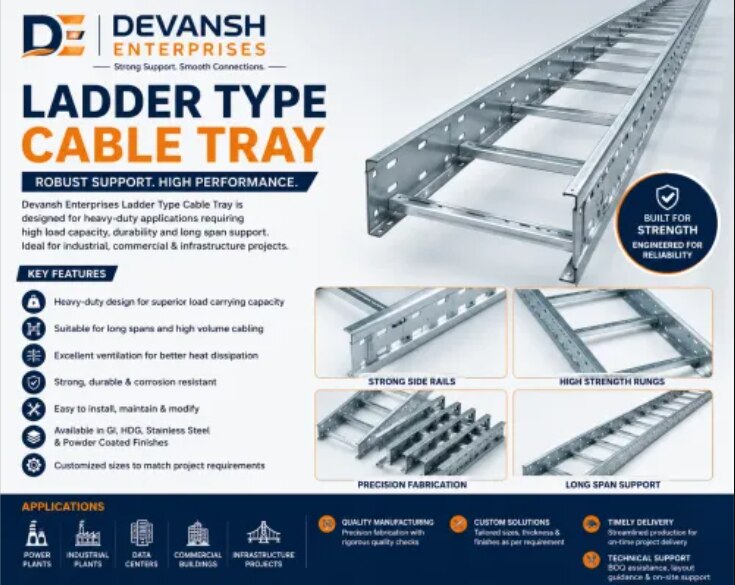
A powder coated cable tray in Pune must be identified by construction, not finish alone. State whether it is perforated, ladder, solid-bottom, channel or wire-mesh: ladder maximises ventilation, perforations support smaller cables, solid bottoms improve protection but restrict airflow, and wire mesh eases access and modification. Channel suits limited cable runs.
- Define the profile and dimensions: overall width, usable internal width, side-rail height or rail depth, sheet thickness, perforation pattern, straight-section length and fitting bend radius.
- Size the usable width from the cable schedule. List every cable, record its outside diameter, add required separation and dividers, reserve spare capacity, then keep occupied width within the project’s allowable fill rule.
- For example, twelve 20 mm cables occupy 240 mm before separation, dividers and spare capacity. The correct tray width therefore depends on those additions and the project fill rule; 300 mm is not a universal answer.
- State the loading criterion and support span. Ask for the manufacturer’s load/span table showing design load at the actual support spacing and the permitted deflection.
- Check the capacity inputs: width, rail depth, thickness, support span, splice position and deflection limit all affect the result. Do not transfer a straight-section rating to a bend or tee.
Request these fields on the drawing or enquiry. A description saying only “powder-coated tray, 300 mm” leaves cable support, ventilation, modification effort and structural capacity unresolved.
How do you verify site fit, supports, bends and earthing?
Verify site fit from a measured route, not from the tray’s nominal width. A fitting that matches the catalogue dimension can still force a power or control cable below its permitted bend radius.
1. Measure the clear route, internal tray width and depth, riser openings, obstructions, and working access around each section. Reserve room for covers, glands, pulling access, maintenance, and future cable additions.
2. Record every cable’s manufacturer-specified minimum bend radius. Check it at horizontal bends, inside and outside vertical risers, tees, crosses, and reducers; select cable tray accessories in Pune by usable radius and internal width, not by a nominal 90-degree label.
3. Match the tray, covers, couplers, splice plates, support brackets, threaded rods, and channel steel before ordering. Confirm the hole pattern, bolt size, side-rail dimensions, fitting radius, coating, and load capacity. Mixed components can leave unsupported fittings or unusable joints.
4. Treat mechanical support and electrical bonding as separate checks. If the tray forms part of the protective-bonding or equipotential system, specify bonding jumpers or listed bonding hardware across painted joints, expansion joints, dissimilar-metal interfaces, and coating-insulated connections.
5. Inspect installed work for damaged coating, loose fasteners, unsupported fittings, open ends, and correct cable separation. Repair cut or scraped coating with the approved method, and do not assume tray selection replaces EMC, safety, or electrical-separation design.
How should you compare Pune suppliers, alternatives and total price?
A single metre rate cannot represent powder coated cable tray price in Pune. Demand separate prices for straight tray, every bend and tee, reducers and crosses, covers, couplers, fasteners, supports, earthing hardware, packing, freight, taxes and non-standard fabrication.
Powder-coated steel suits a specified environment, but cutting, abrasion or unsuitable chemicals expose its protection system. Wire mesh improves access and ventilation; solid-bottom tray protects small cables but restricts airflow.
| Option | Corrosion and ventilation | Weight, modification, maintenance and cost |
|---|---|---|
| Powder-coated steel | Coating-dependent; ventilation follows profile | Moderate; cut edges need treatment; moderate cost |
| GI or pre-galvanized steel | Basic corrosion protection; profile-dependent airflow | Light to moderate; easy to modify; economical |
| Hot-dip galvanized steel | Stronger exposed-steel protection | Heavier; field cuts need repair; higher cost |
| Stainless steel | High corrosion resistance | Heavy and costly; harder to drill |
| Aluminium | Corrosion resistant and light | Easy to handle; lower load capacity can raise design cost |
| Ladder tray | Open, highly ventilated | Light; easy cable access; economical |
| Perforated tray | Good ventilation and small-cable support | Moderate weight; balanced cost |
| Wire-mesh tray | Excellent access and airflow | Light; quick to modify; maintenance-friendly |
| Solid-bottom tray | Enclosed cable support, restricted airflow | Heavier; heat management and cost increase |
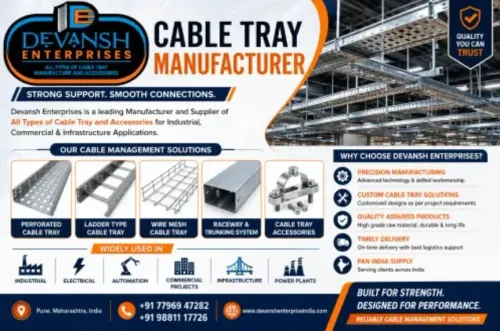
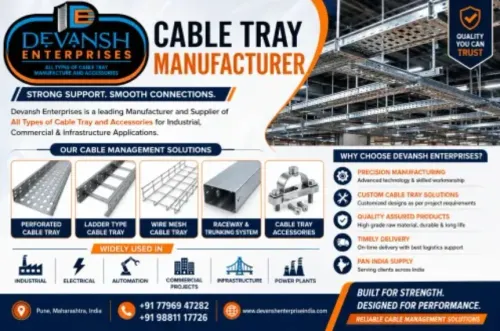
For a powder coated cable tray manufacturer in Pune, ask whether fittings and supports are fabricated in-house or sourced separately. Require matching dimensions, hole patterns, bend radii, coating and colour across the order. Devansh Enterprises can be asked for a line-item, drawing-based quotation, not treated as proof of capacity or certification.
- Confirm substrate, thickness, profile, support span and load basis.
- Match every fitting and support to the drawing.
- Check coating specification, colour and touch-up method.
- Verify quantities, delivery, taxes, exclusions and warranty terms.
Frequently asked questions
What should a complete powder-coated cable tray order contain?
Request straight tray lengths plus bends, tees, reducers, crosses, covers, couplers, bolts, support brackets, hangers, clamps and earthing or bonding hardware. Confirm quantities in a line-by-line bill of materials.
Where is powder-coated cable tray suitable?
Powder coating suits indoor and sheltered installations when the specified coating system matches the environment. Confirm coating thickness, pretreatment, colour, corrosion protection and outdoor or chemical exposure limits before ordering.
How do you select tray profile, dimensions and capacity?
Choose ladder, perforated or solid-bottom construction based on cable support, ventilation and protection needs. Calculate width from cable diameters and spacing, then check the manufacturer’s load rating against cable weight and support spacing.
How do you verify site fit, supports, bends and earthing?
Compare the tray route with site measurements, equipment entry points, wall penetrations and clearance around bends. Confirm support locations, fitting radii, joint hardware and a continuous bonding path connected to the earthing system.
How should you compare Pune suppliers and powder coated cable tray price?
Compare the same steel thickness, tray profile, dimensions, coating specification, fitting quantities, support system, packing, delivery and taxes. Include installation changes and missing accessories in the total price.
Keywords