A cable tray quotation can cover only straight lengths, or it can include the fittings, covers, supports, bonding parts and documents needed for installation. By checking the package line by line, you can compare Pune suppliers accurately, calculate the actual quantity and avoid discovering missing items at site.
Key takeaways
- Require quotations to separate tray lengths, fittings, supports and installation.
- Provide route drawings, tray width, cable load and environmental conditions.
- Match tray material and finish to corrosion, temperature and indoor or outdoor exposure.
- Compare documents, lead times, packaging and replacement terms—not only the unit price.
What should a cable tray supply quotation include by default?
A cable tray supply is not a universal package. If you are comparing a cable tray for supply in Pune, require the quotation to state whether the price covers straight tray lengths only or a complete route with fittings and supports.
Ask for a line-by-line bill of quantities containing:
- Straight tray lengths, the supply unit length such as 2.5 m or 3 m, tray type, finish, and quantity
- Covers, priced by location and duty rather than assumed for every run
- Couplers or splice plates, bolts, nuts, washers, and all fitting hardware
- Bends, elbows, tees, crosses, reducers, risers, and drop-outs
- Items included in the tray-only price, separated from items requiring a separate quotation
- Support brackets, hangers, threaded rods, clamps, and anchor fasteners
- Dividers, separator brackets, earthing or bonding jumpers, and expansion joints
- Installation drawings, marked separately from fabrication or supply items
- Piece marks matching the tray schedule, packing method, freight, unloading, and site delivery
A tray-only price commonly includes straight sections, standard fittings, splice hardware, and basic fasteners. Support steel, anchors, dividers, bonding accessories, expansion joints, and drawings are frequently excluded; do not accept “complete supply” without line-item confirmation. Covers belong only where the route needs protection, such as outdoors, vertical sections, or areas exposed to falling objects.
Bonding accessories must be listed explicitly, because an unpriced jumper is an installation omission, not a free inclusion.
What order details does a Pune buyer need to provide?
A buyer seeking cable tray order details in Pune should send a complete design brief before requesting a price. Nominal width alone is insufficient: rail geometry, material and support span change the tray’s capacity.
1. Specify the tray system type, material, finish, width, side-rail height, sheet thickness or section size, standard supplied length, perforation pattern, cover requirement, fitting radius, load class, support span, quantity, delivery location and application.
2. Calculate straight lengths by dividing the measured route by the supplied piece length, such as 2.5 m or 3 m. Round up, then add allowance for joint overlap, bends, risers, tees, elevation changes and cutting waste.
3. Attach a route drawing or tray schedule showing every straight section, horizontal and vertical bend, riser, tee, cross, reducer, elevation change, cover, drop-out and support location. Without it, a low quotation may simply omit installation-critical fittings.
4. Confirm usable inside width, side-rail orientation, fitting radius and whether fittings arrive assembled or field-bolted. Route centre-line dimensions and a supplier’s outside dimensions can produce different fitting quantities.
5. State cable separation requirements for power, control, instrumentation and communication cables. Request separate trays, dividers or defined spacing where the design requires segregation; list dividers and separator brackets as separate line items.
How do you choose tray type, width and load capacity?
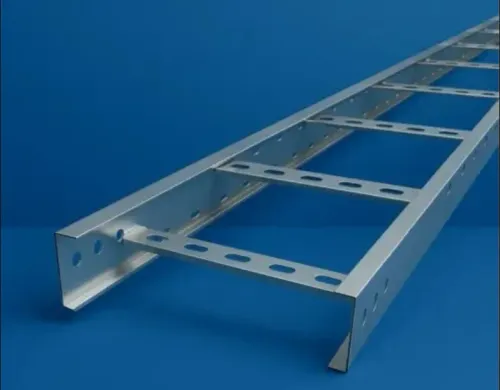
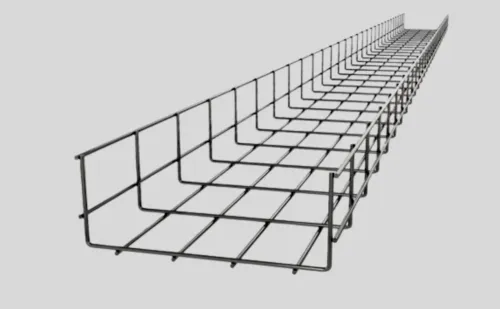
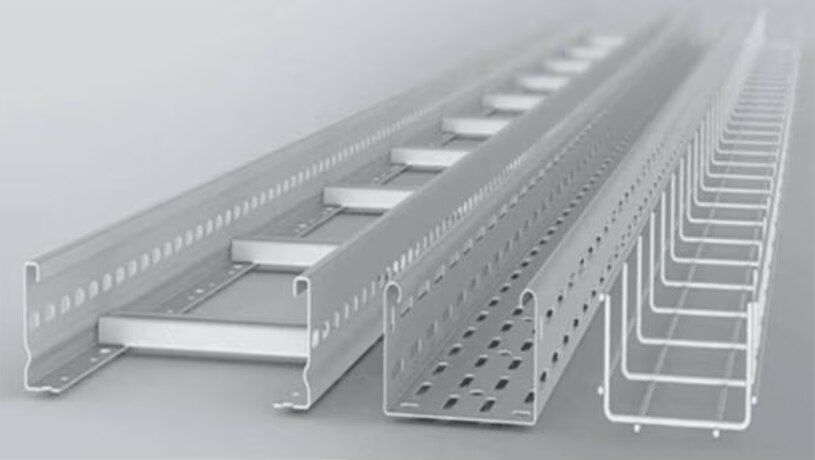
Ladder, perforated, solid-bottom and wire-mesh trays are system choices, not interchangeable price categories. Select the geometry by cable support, ventilation, cleaning, access and installation effort.
| Tray type | Best fit | Main trade-off |
|---|---|---|
| Ladder | Ventilated power-cable runs | Strong airflow and easy access, but cables receive less continuous support |
| Perforated | Cables needing frequent support | More continuous support, with more surface to clean |
| Solid-bottom | Small cables or falling-debris areas | Strong protection, but reduced ventilation and harder inspection |
| Wire-mesh or basket | Light, frequently modified routes | Fast field cutting and access, but lower heavy-load capability |
| Hot-dip-galvanized | Corrosive or outdoor environments | Corrosion-protection finish applied to a tray geometry; it is not a separate geometry |
Choose width from the cable outside diameters, cable count, required separation, bend space and spare capacity. Add the diameters of cables sharing each section, reserve space for power-to-control separation and bend radii, then add a defined future allowance. Route length cannot determine width.
Tie allowable load to the actual support span, deflection limit, splice position, cantilever loading and cover weight. Ask for the manufacturer’s load table or calculation for the offered series, showing the installation arrangement and test basis; reject a single “maximum load” number without those conditions.
For industrial cable tray supply in Maharashtra, require the quotation to state width, side-rail height, thickness or section size, fitting radius, finish and support span. That specification prevents a ventilated ladder system from being compared with a protected solid-bottom system on price alone.
Which material, finish and environmental documents should you request?
Request a quotation or test file that separates material from finish and records the environment the tray will face. Generic “GI tray” is incomplete.
| Option | What it means | Failure or fit |
|---|---|---|
| Hot-dip-galvanized steel | Fabricated steel dipped after manufacture; state the galvanizing standard and coating thickness | Robust general industrial choice; damaged areas and cut edges still need inspection |
| Pre-galvanized steel | Zinc-coated sheet formed after coating | Check cut edges, drilled holes and fabricated fittings, where zinc protection is interrupted |
| Electro-galvanized steel | Electrically deposited zinc layer | Suits controlled indoor conditions; thin protection is a weak specification for wet or corrosive exposure |
| Powder-coated steel | Baked polymer coating over prepared steel | Scrutinise ultraviolet exposure, washdown, impact and damaged edges; rust can spread beneath a breach |
| Painted steel | Liquid protective coating over prepared steel | Demand surface-preparation records and repair method for scratches; outdoor ultraviolet and washdown accelerate failure |
| Aluminium | Corrosion-resistant, lightweight metal | Check alloy grade, strength, galvanic contact with other metals and suitability for the load |
| Stainless steel | Specify grade, such as 304 or 316, rather than “stainless” | Unnecessary for a dry indoor route; valuable in aggressive chemical or washdown areas |
Confirm these conditions in writing:
- Indoor or outdoor location, humidity and operating temperature
- Chemical vapour, industrial atmosphere and coastal salt exposure
- Washdown method, ultraviolet exposure and expected contamination
Require coating thickness, galvanizing stage and named standard, corrosion category or test basis, material grade, dimensional tolerances, weld-quality requirements, material certificates, dimensional inspection and surface-finish evidence. Do not accept “as per standard” unless the purchase order names the standard and the inspection documents to be supplied.
How can you compare a Pune manufacturer’s complete supply package?
Compare prices only after normalising the specification. Use the same tray geometry, material, width, thickness, support span, load table, fitting radius, cover duty and finish for every quotation.
| Item | Quote A | Quote B |
|---|---|---|
| Tray basis | Geometry, width, thickness and material | Geometry, width, thickness and material |
| Performance | Support span, load table and deflection basis | Support span, load table and deflection basis |
| Fittings | Radius, bends, tees, reducers and risers | Radius, bends, tees, reducers and risers |
| Protection | Cover duty, finish and coating evidence | Cover duty, finish and coating evidence |
Audit the package line by line. Confirm whether it includes engineered supports, hangers, brackets, anchors, expansion joints, bonding jumpers, dividers, installation drawings, material certificates, dimensional inspection records and packing protection.
- Split standard straight sections from non-standard widths, large-radius bends, reducers, stainless-steel items, special coatings and engineered supports; these can carry different fabrication lead times.
- For long outdoor metallic runs, specify expansion provisions, bonding across each joint and the support arrangement. Without them, temperature movement can buckle the tray, damage joints or interrupt electrical continuity.
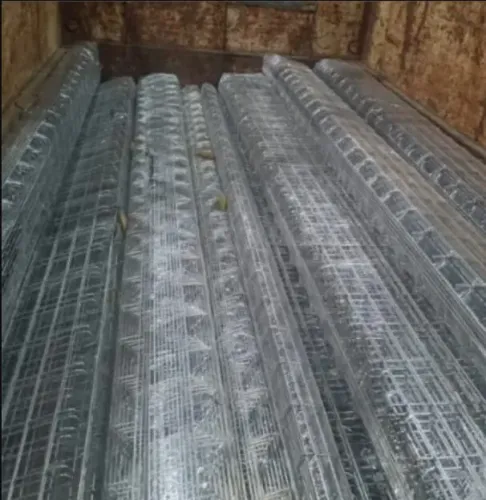
- Put bundle identification, piece-marking against the tray schedule and finished-surface protection in the dispatch terms. State whether freight, unloading and site delivery are included.
Assess a cable tray manufacturer in Pune, including Devansh Enterprises, through documented scope rather than general claims. For industrial cable tray supply in Maharashtra, require a line-by-line bill of quantities and mark every item included, excluded and delivered to the site.
Frequently asked questions
What should a cable tray supply quotation include by default?
Ask the quotation to list straight tray lengths, bends, tees, reducers, covers, couplers, supports, fasteners, delivery, taxes and installation separately.
What order details does a Pune buyer need to provide?
Provide route drawings, tray type, width, length, cable quantity and weight, support spacing, installation location, delivery address and required date.
How do you choose cable tray type, width and load capacity?
Choose the tray form for the cable arrangement, size the width for the cable bundle plus separation and future capacity, and verify load capacity against cable weight and support spacing.
Which material, finish and environmental documents should you request?
Request the material grade, coating or galvanizing details, thickness, test reports, dimensional drawings and corrosion or environmental suitability documents.
How can you compare a Pune manufacturer’s complete supply package?
Compare the same route scope, component list, specifications, documents, delivery terms, packaging, warranty and exclusions before comparing prices.
Keywords